 Menu
Menu

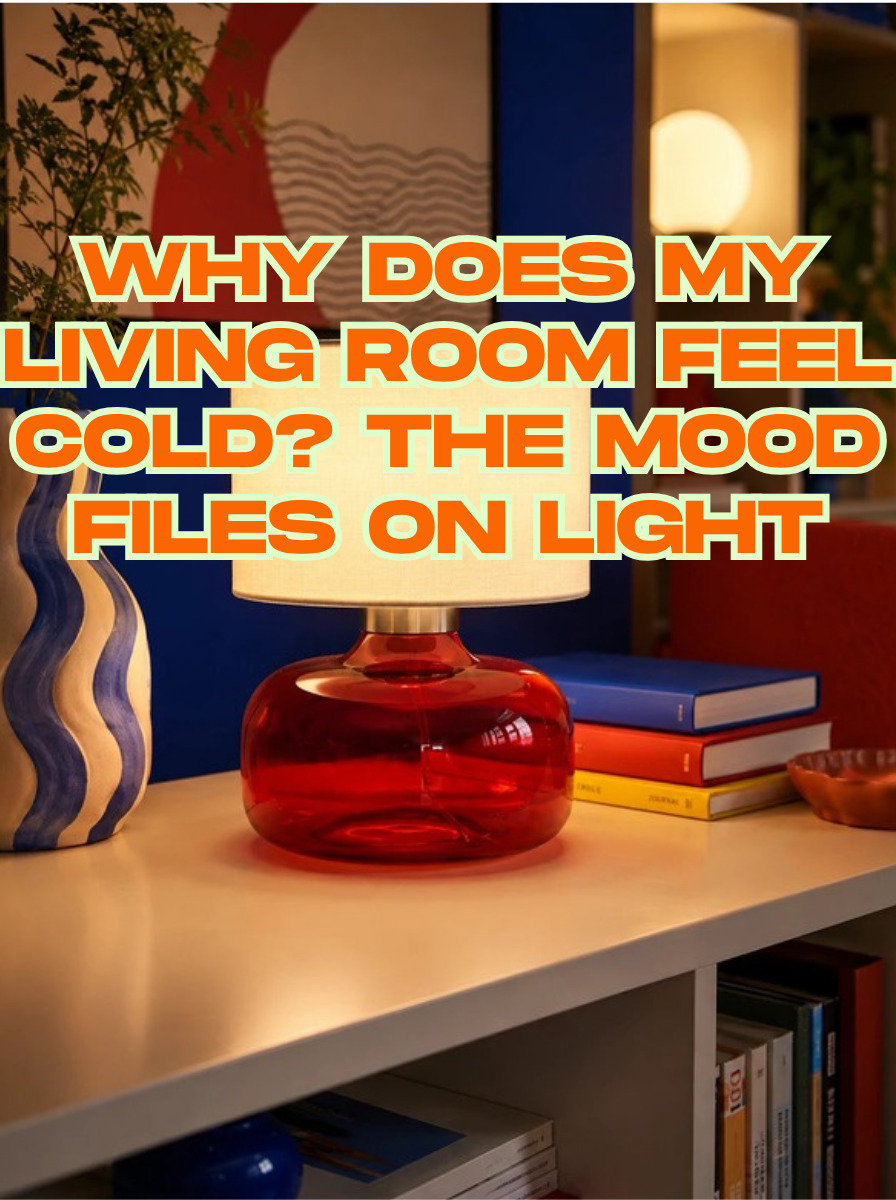
Nobody has measured a lamp changing your brain chemistry. What researchers have measured is narrower and more useful: what the color of evening light does to your body. So: the honest version, then what you can do tonight.
It's 9 PM. The room was fine at two in the afternoon. You flick the ceiling light on and it reads like a waiting area.
The short answer: a living room feels cold at night because one bright, cool-toned source is firing down from the ceiling. Replace it with two or three warmer, lower lights — around 2,700K, at sitting height or below — and the same room reads warm. No new furniture, and the fix can start with a pack of bulbs.
Why does my living room feel cold at night when it looked fine all day?
A room turns cold after dark because daylight came through a window at an angle and filled it sideways, while a ceiling fixture fires straight down from one point. Overhead light flattens faces, drops hard shadows, and lights the middle of the floor — the part of a room nobody looks at. The question people actually type — why does my living room feel cold — nearly always has a lighting answer, not a heating one. And the bulb in most rental fixtures is cooler and bluer than anything you'd pick.
Does warm light actually do anything, or is it just a vibe?
Warm light does something measurable in the evening, though the evidence is narrower than the internet suggests. In one small controlled study, sixteen men aged 20–28 spent two evening hours under three lights of identical brightness — about 40 lux — but different color temperatures. Under the bluest (6,500K) their melatonin rose only 29.5% from baseline, against 49% under 3,000K and 42% under 2,500K. Same brightness, different color, different physiology (Chellappa et al., 2011, PLoS ONE).
Hold that loosely: sixteen young men, in a lab, under conditions the authors themselves flag as a step from real rooms. It's a signal, not a law — though Harvard Health reports blue light suppressing melatonin about twice as long as green light of comparable brightness.
The mood half is softer. Among 60 dual-income spouses, wives whose home-tour language called the place restorative showed steeper, healthier daily cortisol slopes than those describing clutter (Saxbe & Repetti, 2010) — a correlation between how people talk about a room and their physiology, not evidence that a lamp touches your hormones.
What color temperature should living room lights be at night?
Living room lights should sit at 2,700K after dark. That number is printed on every bulb box as "warm white," and it falls well below the roughly 4,000K-and-up range associated with evening melatonin suppression. 3,000K is fine; 4,000K "cool white" and 5,000K "daylight" belong in a kitchen. If you change one thing this week, change the bulbs — it's the highest-return move here, and it upgrades every fixture you own.
How do I make my living room feel warm instead of cold?
Turn the ceiling light off and replace it with three smaller sources at three heights: one at sitting height, one on the wall, one low. You want pools of light with dark between them, not an even wash. Three warm pools read as intentional; one floodlight reads as a corridor.
Layer one — the anchor. A table lamp on the surface nearest where you actually sit, shade at roughly shoulder height when seated. It does most of the work, so pick one you like looking at even switched off.

A shade that leaks light upward as well as down lifts the ceiling instead of spotlighting the table — a stained-glass table lamp like this one throws both ways and takes a standard E27 bulb, so you set the color temperature yourself.

What lamp gives a warm cozy amber glow in a living room with no ceiling light?
The lamp that gives a warm amber glow is one with a colored, diffusing body — amber acrylic, tinted glass, frosted resin — because the material warms the light before it reaches the room. Color in the shade does what a Kelvin number can't: it tints the wall behind it, and that is what makes a corner read as glowing rather than lit.

Pick one that dims, because a fixed-brightness accent light is only right for about an hour of the evening — the tangerine donut wall lamp cycles white, warm and neutral from a touch on its top edge and runs on USB-C.

Tangerine Donut Wall Lamp
"The light is warm and soft — not too bright, just right for winding down in the evening." — Ethan, 5★
Do wall lamps work in a colorful living room?
Wall lamps work better in a colorful living room than in a neutral one, because a wall lamp lights the wall — and in a colorful room the wall is already doing something. A warm pool deepens saturated color after dark instead of bleaching it, which is when bold paint usually stops working. Mount at standing eye level or above a sideboard, never near the ceiling.

Renters get the better version now that rechargeable wall lights exist — a cordless sunset lightbox lamp is a 6 cm-deep panel whose 5 W LED washes one to three square meters of wall, with no cord to hide and nothing to hardwire.
How many lamps does a living room actually need?
Three lamps is the working number for a standard rental living room, and two is enough for a small one. Past four you stop making pools and start making the even wash you were escaping. Count light sources, not fixtures: a candle counts, a lit shelf counts, a laptop doesn't. The third layer is the cheapest and the one people skip — something low or at the edge, killing the dark zones that make a lamp-lit room feel half-finished.

Adhesive-mounted, battery-run fittings reach the corners power doesn't — a motion-sensor cordless bar light is a 19.9 x 6.4 cm (8 x 3 in) strip that sticks under a shelf and wakes to a soft warm glow as you pass. Everything in the colorful lighting collection is inspected before it ships and goes out free to the US and Canada, duties included.
What should I skip?
Skip any plan that expects one decorative lamp to light a whole room. Here's the part the lighting blogs can't write, because it comes from our own customers.
We pulled every review on the store on 29 August 2026 — 868 of them, covering purchases from late April to early August. Filtered to lighting, that's 227 reviews across 46 lamps. Forty-seven (21%) volunteer the words warm, amber or soft glow unprompted. Not one calls a light too harsh, too bright or too cool-toned — all five reviews containing "harsh" or "too bright" use them to say the lamp isn't.
What people regret is scale. Three reviewers wrote a version of the same sentence: "it's definitely more of a small accent lamp than a main light." They're right, and it's this article's honest warning: an accent lamp will not light your room. Buy the anchor first, the pretty small ones second. Fifteen of the 227 mention the cord, so settle power before looks.
Skip smart bulbs if you only ever want one setting, and skip RGB strips as your main warm source — they render skin tones badly. Two honest comparisons: for app-controlled scenes across a room, Philips Hue does it properly and we don't compete there, at the cost of per-bulb price and another account. For the cheapest layered warmth, IKEA's table and clamp lamps are hard to beat, but you're buying a fitting rather than an object worth displaying switched off.
Decorate your mood.
Two minutes, a handful of questions, and you'll know which palette and which glow your room has been missing.
Frequently asked questions
Why does a living room feel cold even with the lights on?
Usually because all the light comes from one cool-toned ceiling fixture. A single overhead source lights the floor, flattens faces and leaves the walls dark, which reads as institutional. Two or three warmer, lower lamps fix it.
Is warm white or soft white better for a living room?
They are usually the same thing — both normally mean around 2,700K, the right target after dark. Check the Kelvin number on the box rather than the marketing name, because "soft white" is used inconsistently between brands.
Can I get warm lighting in a rental without rewiring?
Yes, and it is now the normal case. Plug-in and rechargeable wall lamps, adhesive-mounted bar lights and table lamps cover all three layers with no electrician and no holes. The real constraint is where your outlets are.
Does warm light actually help you relax?
Research suggests warmer evening light interferes less with melatonin than cooler light of the same brightness, which is why sleep guidance favors it. That is a modest finding from small studies — not a promise about how you will feel, and not a treatment for anything.
More from The Mood Files: does dopamine decor actually work and why your room makes you tired. No ceiling fixture at all? The three-zone plan is the companion piece; the Gen Z living room guide covers the rest.
Written by the Retro Radius Team. Review data pulled 29 August 2026 (n = 227 lighting reviews).
Share:
Rug Size for a Small Living Room: What Actually Fits
What Size Lamp for a Living Room? A Real Sizing Guide