 Menu
Menu

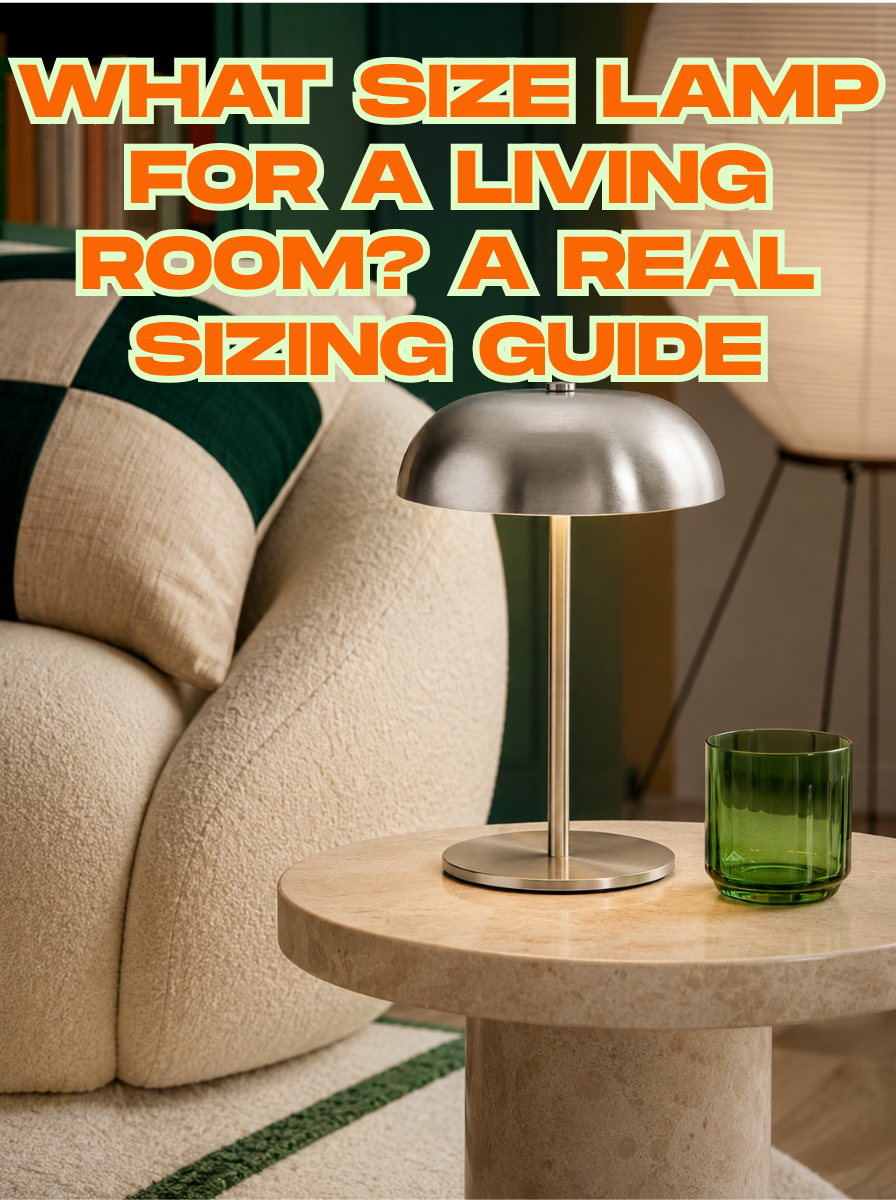
It is 9 PM, you have been at a screen since morning, and the lamp you bought because it looked perfect in the photo is lighting about a placemat's worth of your living room. It is not broken. It was never sized for the job you gave it.
Short answer: for a living room side table, look for a lamp roughly 26–34 inches tall, with the bottom of the shade at your eye level when you are seated. Then check brightness separately: a living room wants around 10–20 lumens per square foot across all its light sources. Height decides how it looks. Lumens decide whether the room is lit.
What size lamp for a living room?
A living room table lamp should stand about 26–34 inches (66–86 cm) tall, and lamp plus table should total roughly 58–64 inches (147–163 cm) from the floor, per published lamp sizing guidance. That combined number is the one that matters, because it puts the shade at seated eye level: the same 30-inch lamp gives two different results on a 30-inch console and a 16-inch side table.
How tall should a table lamp be next to a sofa?
Next to a sofa, the bottom edge of the shade should sit level with your eyes when you are seated — usually 58–64 inches off the floor once the table is counted. Above that line you see the bulb and get glare. Below it, light pools on the table instead of reaching your book.
How many lumens does a living room actually need?
Lighting guides put a living room at roughly 10–20 foot-candles, and one foot-candle is one lumen per square foot. So a 180-square-foot living room wants 1,800 to 3,600 lumens in total. That is why good-looking rooms feel dim: one decorative lamp rarely exceeds a few hundred lumens. You are not short a lamp. You are short about 2,000 lumens.
What is the difference between an accent lamp and a main light?
An accent lamp lights an object, a corner, or a mood; a main light lights a room. The difference is output, not quality, and almost every small sculptural lamp sold as decor is the first kind. Buying one expecting the second is the most common lighting mistake we see — and we can put a number on it.
What 211 lighting reviews told us about scale
On 1 September 2026 we read every review on our store — 869 verified Judge.me reviews, 211 across 42 lighting products — and sorted the criticism. Twenty-five of those 211 reviews (12%) say a version of "I wish it were taller, wider, bigger." That is the single most common complaint we get about a lamp. Zero say a lamp was too dim to use, and zero complain that a lamp is harsh or too bright — the only two reviews using those words use them to say the lamp is not. Meanwhile 53 (25%) praise the warm, soft glow unprompted.
The clearest version comes from Farrer, who gave our Colored Glass Table Lamp three stars: "the design is super stylish and minimalist, but it's definitely more of a small accent lamp than a main light." That is a fair review, and it is also the whole article. And 23 of the 25 are four-star reviews — people liked the lamp, they expected more of it. Scale mismatch, not a defect.
How tall should a floor lamp be in a living room?
A floor lamp usually runs 58–64 inches (147–163 cm) tall — the eye-level target a table lamp only reaches with help from a table. They earn their place in small rooms by buying height without using a surface. Uplighters do the most work per watt: bounce a beam off a pale ceiling and the whole plane becomes a soft second source.

That is the idea behind a sunset-toned projection floor lamp, which stands on a 19 × 15.5 cm (7 × 6 in) footprint and throws five rotatable circles of warm light up the wall instead of down onto a table.

One honest caveat, straight off our own product page: that is mood lighting, not a reading light.
What size lamp works on a small side table?
On a side table narrower than about 16 inches, size by footprint rather than height: the base should take up no more than a third of the surface, or you have bought a lamp table rather than a side table. Small cordless lamps win here — honest accent lights that leave room for a glass and a phone, with nothing tethered to an outlet.

A cordless metal mushroom table lamp is a worked example: 15.5 cm wide, 20.5 cm tall, USB-rechargeable, with a heavy iron shade aiming light down into a pool rather than out into the room.

"I created a little reading nook and this lamp is the centerpiece. The soft warm glow is perfect for reading at night." — Ryan B., verified buyer. That is an accent lamp used exactly as one: one seat, one task, one pool of light. Sized on purpose, it works.
Is warm white or soft white better for a living room?
After dark, warmer is the safer default — around 2,700K, which most bulbs label "soft white" or "warm white" (the terms overlap, and are often the same thing on the box). Cooler light above 4,000K reads as office lighting in a room meant for sitting still. Research suggests this is not only aesthetic: Harvard Health reports a study in which blue light suppressed melatonin about twice as long as green light and shifted circadian rhythms about twice as much (3 hours versus 1.5). Modest — and a fair argument for keeping cool bulbs in the kitchen. We unpack the evidence in our Mood Files piece on why a living room feels cold.
How many lamps do you need in a living room with no ceiling light?
Plan on three to four sources at different heights rather than one bright one: a floor lamp for reach, a table lamp for the seating zone, and something on a wall or shelf for the dark corner. Three modest sources at three heights read as a considered room; one powerful source reads as an interrogation. If your side tables are full, the light moves to the wall.

Renters can do that without an electrician: the plug-in donut wall lamp mounts as a 30 cm (12 in) ring on USB-C power, with three colour-temperature settings and long-press dimming.
What to skip
Asking what size lamp for a living room is really two questions — how tall, and how bright — and most disappointment comes from answering only the first. So: skip a second decorative accent lamp when the room is dim — two of them still will not reach the lumen number, and now you have two cords. Skip any lamp whose shade is nearly as wide as its table. And skip the idea that taller means brighter; height governs how far light travels, the bulb governs how much there is to travel.
Two alternatives worth comparing honestly, neither of them us. If you need a plain tall floor lamp aimed at the ceiling, a big-box basic — IKEA's range being the obvious one — does that job for less; the trade-off is a fixture, not an object. If you already own lamps you like, a dimmable smart bulb such as Philips Hue buys brightness and colour-temperature control without another lamp; the trade-off is per-bulb cost and one more app. We win in the middle of that trade — pieces chosen to sit together in a colourful room, which is what our colourful and retro lighting collection is curated for.
Sizing something other than lamps? The same eye-level logic runs through our wall art size guide and our rug size guide.
FAQ
What size lamp should go on a 20-inch side table?
About 24–28 inches, so table and lamp together land near the 58–64 inch eye-level band. Keep the base under about 7 inches so there is room for a glass.
Can a table lamp be the only light in a living room?
Rarely. A living room wants roughly 10–20 lumens per square foot in total, and one decorative table lamp supplies a fraction of that. Use it as one of three sources.
Is a lamp shade supposed to be wider than the table?
No. The shade should sit comfortably inside the table's footprint. If it overhangs, the lamp reads top-heavy and you will knock it.
What if the lamp arrives smaller than it looked online?
It is the most common surprise in our own reviews, so check the listed dimensions against a ruler rather than judging by the photo. Every US and Canada order ships free with duties included, each is inspected before dispatch, and verified transit damage is replaced — but wrong scale is a fit problem no policy fixes.
Decorate your mood.
Not sure which vibe is yours? Take the two-minute style quiz and we will point you at the pieces that fit your room.
Retro Radius Team · 1 September 2026. Review figures are our own, pulled that day.
Share:
Why Does My Living Room Feel Cold? The Mood Files on Light
Rental Bathroom Ideas: What to Change First When You Can't Touch the Tile