 Menu
Menu

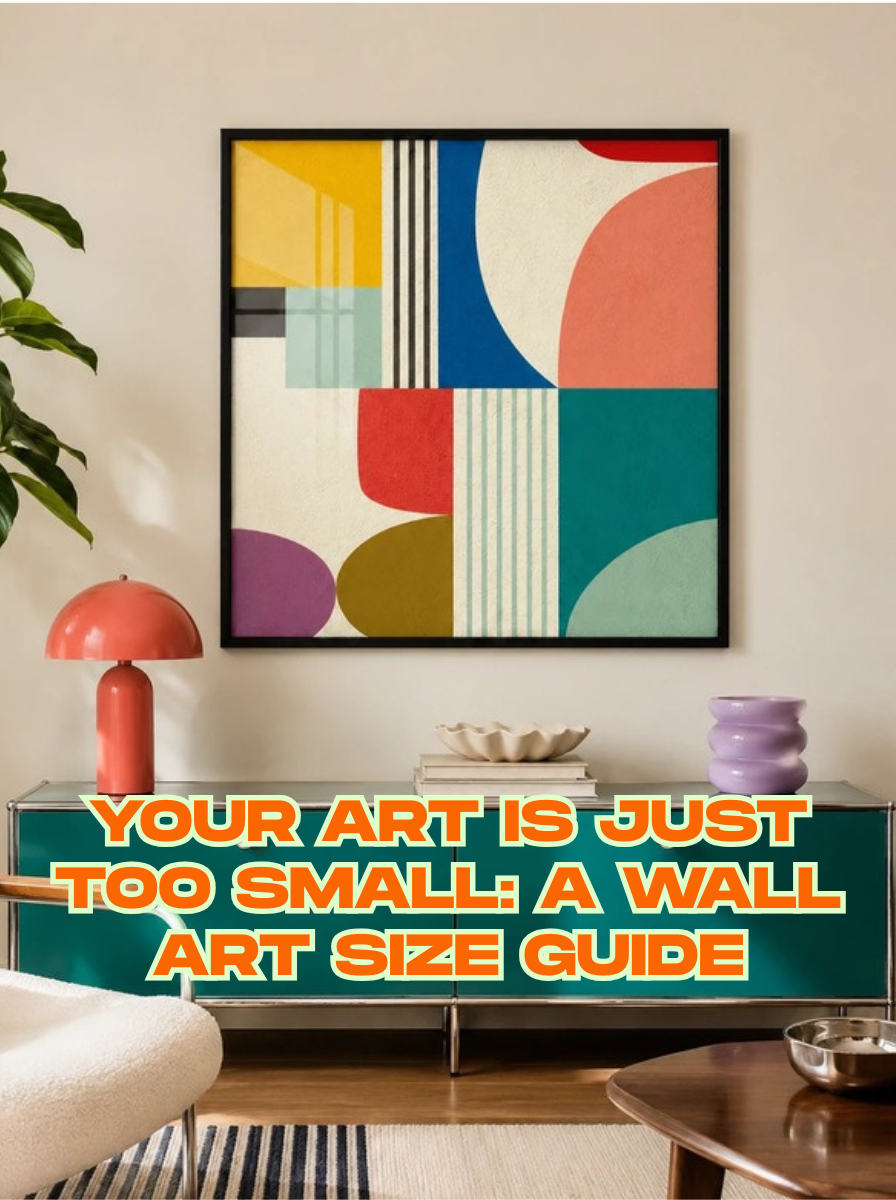
First weekend after move-in: bed made, desk set, one poster up — and the wall still reads empty. It's the most repeated bare-wall thread on Reddit, and the replies always say "it needs art" without saying what size. Here's the size: art should span about two-thirds of the width of the furniture under it, hang with its bottom edge 6–8 inches above that furniture, and if one piece can't reach the width, a pair or trio hung as one shape counts as one piece. Most walls that "need art" already have art on them. It's just too small.
Wall art size guide: why does my art look too small?
Because your eye measures art against the furniture below it, not the wall — and a single print under half the width of a sofa, bed, or desk reads as an afterthought no matter how good the print is.
The designers' rule is blunt: artwork should be roughly two-thirds the width of the furniture it hangs above. On a bare wall with nothing beneath, the target becomes the wall: framing guides put a focal piece at 55–80% of the wall's width. Height matters too — a piece hung near the ceiling looks smaller than the same piece at eye level, which is why galleries centre work at 57–62 inches from the floor.
Our own buyers confirm which way the mistake runs. Of the 51 reviews on the wall-art pieces in our store (869-review public feed, counted August 15, 2026), eight say some version of "smaller than I expected" — and zero say "too big." When they name what they wanted, it's always width: "a few inches wider," never taller. So this is a wall art size guide built around width — the arithmetic for the four surfaces a small room actually has, then how to reach that width with prints you can afford, or already own.
What size wall art goes above a sofa?
About 56 inches wide over a standard 84-inch three-seater, 40 inches over a 60-inch loveseat — and almost no single affordable print gets there, so plan on two or three pieces treated as one.
The gap rule comes with it: 6 to 8 inches between the sofa back and the bottom of the frame — higher and the art floats off the furniture and the wall reads empty again, even at the right width.
Honesty about our own shelf: the biggest single piece we sell is 50 × 70 cm (20 × 28 in — as tall as a desk is high), half of what an 84-inch sofa wants. So over a sofa we don't recommend one piece; we recommend a row. Three 40 cm (16 in) squares — each a bit wider than a vinyl sleeve — with 4-inch gaps come to 56 inches exactly. That's the recipe our square geometric canvas print is sold for, in 20, 30 and 40 cm. Anna, five stars, found the move herself: "I paired this with another print on my wall and they look amazing together." If you truly want one oversized 36 × 48-in statement canvas instead, a big-box store or print-on-demand shop is the honest place — we don't sell that size — with the trade-off of a catalogue everyone else has, and framing usually extra.


The squares we mean: Geometric Abstract Canvas Print
Six designs, three sizes (8, 12, 16 in) — a trio hits the two-thirds line over a sofa or console.
See itBudget note: the 16-inch trio is the priciest recipe here; the 12-inch trio (about 42 in with gaps) stays under $125 and is the loveseat version.
How big should art be above a bed (twin XL or full)?
About 25 inches wide over a twin XL, about 36 over a full — measured against the headboard if you have one.
A twin XL is 38 inches wide (Sleep Foundation), so two-thirds is 25: two 12 × 16 in frames with a 2-in gap land at 26. A full is 54 inches, so aim for 36 — three 12-in squares, or two 20 × 28 posters. Bed walls are also where dorm rules bite hardest: no nails.

Self-adhesive felt squares solve that wall: sold from 20 to 50 cm (8 to 20 in — the biggest is a throw pillow) and made to cluster, a 20-in plus an 8-in reaches the twin XL line with no nail. Ours is the gradient felt wall panel. Even here the width story repeats — Stella, four stars, wished "it was wider to cover more of the wall." She's right: one panel is a starting square, not a finished wall.
What size art fits above a desk?
About 28 inches wide over a standard 42-inch dorm desk — which usually means two mid-size frames, not one.
UCLA lists its dorm desks at 42–43 inches wide (the rest of that desk's math is in our dorm desk fit guide), so two-thirds is 28. If a monitor sits on the desk, treat its top edge as the "furniture" and start the art 6–8 inches above it.

Two 30 × 40 cm frames (12 × 16 in — a magazine spread each, around 550 g or a bit over a can of soup) with a 2-in gap make 26 inches, and stay light enough for the adhesive hooks dorms allow (weight math in our no-drill hanging guide). That's the size our aluminum-framed art print comes in. One alone is the classic too-small mistake — Willow, four stars, wished "the frame size was a little larger for my wall." One frame isn't the wrong product; it's half the recipe.
Set of two prints or one big piece?
One big piece if it can actually reach two-thirds of the width; otherwise a pair or trio at the same size and spacing, hung as one rectangle — never one small piece centred alone.
What makes a set read as one piece is discipline, not quantity: same size, same gap (2–4 in), tops aligned, the group centred on the furniture. Three feels finished; five feels like a project, and there's a reason to stop: in a study of nearly 1,400 adults, clutter measurably weakened people's sense of home (Roster, Ferrari & Jurkat, 2016, Journal of Environmental Psychology). Research suggests, not promises — but the practical version holds: fewer, bigger, aligned.

Sizes make the call easy: pick a print sold in a ladder of sizes and buy the one the furniture dictates. Our record player art poster runs five, from 21 × 30 cm (8 × 12 in) to 50 × 70 cm (20 × 28 in). The 20-in top size is a one-piece answer for a 30-in dresser and a two-piece answer for anything wider — and its own reviews are the lesson: Lynda gave a small size three stars, "a bit smaller than i imagined for a main wall piece." Same poster, five widths; the difference is the furniture under it.

The size ladder we mean: Record Player Art Poster
Five sizes from 8 × 12 to 20 × 28 in, unframed and rolled — buy the width the furniture asks for, not the default.
See itOne caveat from the same reviews: unframed posters mean sourcing a frame, and one buyer found "finding one that fits this size was kinda annoying." The cheap fix is the Reddit crowd's favourite — thrift and estate-sale frames, a paper print cut to fit — with the trade-off of time and glass that may not match across a set. Once, for the whole article: everything in our store ships free to the US and Canada, duties included, and is inspected before dispatch.
How do you make small art you already own look bigger for $0?
Group it, lower it, mat it — three fixes that cost nothing and solve most "empty wall" threads.
- Regroup what you own into one rectangle. Two or three pieces matched by size or at least frame colour, hung 2–4 in apart with tops aligned and centred on the furniture, beat one new piece almost every time. Measure, take two-thirds, stop adding when you hit it.
- Lower it. Most first-apartment art hangs too high. Drop it until the centre sits at 57–62 in, or the bottom edge 6–8 in above the sofa or headboard. Same print, instantly bigger.
- Mat it. A wide mat in a bigger thrifted frame buys 4–6 in of width — the oldest framing trick there is.
- Choose it yourself. There's evidence behind the mindset: in University of Exeter workplace experiments, people allowed to arrange their own space with art and objects were 32% more productive than those in bare rooms (Knight & Haslam, 2010). Research suggests, no more — but the wall you sized and hung yourself is the one that counts (more in our dopamine-decor explainer).
What should you skip when buying wall art for a small room?
Anything you're buying because it's cheap and small — the two words that produce the empty-wall photo — and sellers list the small size first because it's cheapest, including us. Read the furniture width before the dropdown.
- One 8 × 10 over a sofa. Not bad art — a quarter of the width the eye expects. Buy the pair or skip it.
- Mismatched sets. Three sizes in three frames read as clutter, not a gallery wall. Match one variable before you hang.
- The nail you found. The old hole is at the last tenant's height. Measure to 57–62 in centre and use a removable hook — our no-nails wall guide covers the how; this article is the what-size.
FAQ
What is the two-thirds rule for wall art?
Art — or a group hung as one shape — should be about two-thirds the width of the furniture beneath it: roughly 56 in over an 84-in sofa, 25 in over a 38-in twin XL bed, 28 in over a 42-in desk. On an empty wall with no furniture, aim for 55–80% of the wall's width.
How high should I hang art above a sofa or bed?
Leave 6–8 inches between the top of the sofa or headboard and the bottom of the frame. On a wall with nothing beneath, centre the piece or group at 57–62 inches from the floor — the height galleries use.
Can I use two small prints instead of one large one?
Yes, and in a small room it's usually the better answer. Match size and frame, keep 2–4 inches between pieces, align the tops, and centre the group on the furniture. Two 12 × 16 in frames make a 26-inch group — right for a twin XL bed or a dorm desk.
Why does everyone say my wall "needs art" when there's already art on it?
Because it's too small for the furniture below it, and probably hung too high. Regroup what you own into one aligned rectangle at two-thirds of the furniture width, drop it to eye level, and the same pieces read as finished.
That's the whole guide: measure the furniture, take two-thirds, hang the bottom edge a hand's width above it, and let a pair or trio count as one piece when nothing single is wide enough. Do it with the prints you already own first — most "empty" walls are one regrouping away from done. Our wall art collection is sized in ladders and squares for that reason, but the tape measure comes first.
Decorate your mood.
Not sure which vibe your room is missing? The quiz takes 2 minutes.
Find your vibe →
Share:
How to Light a Dorm Room Without a Ceiling Light (The 3-Zone Plan)
The Second Dorm List: 5 Things People Forget to Buy for Their Dorm Room (Until Week One)