 Menu
Menu

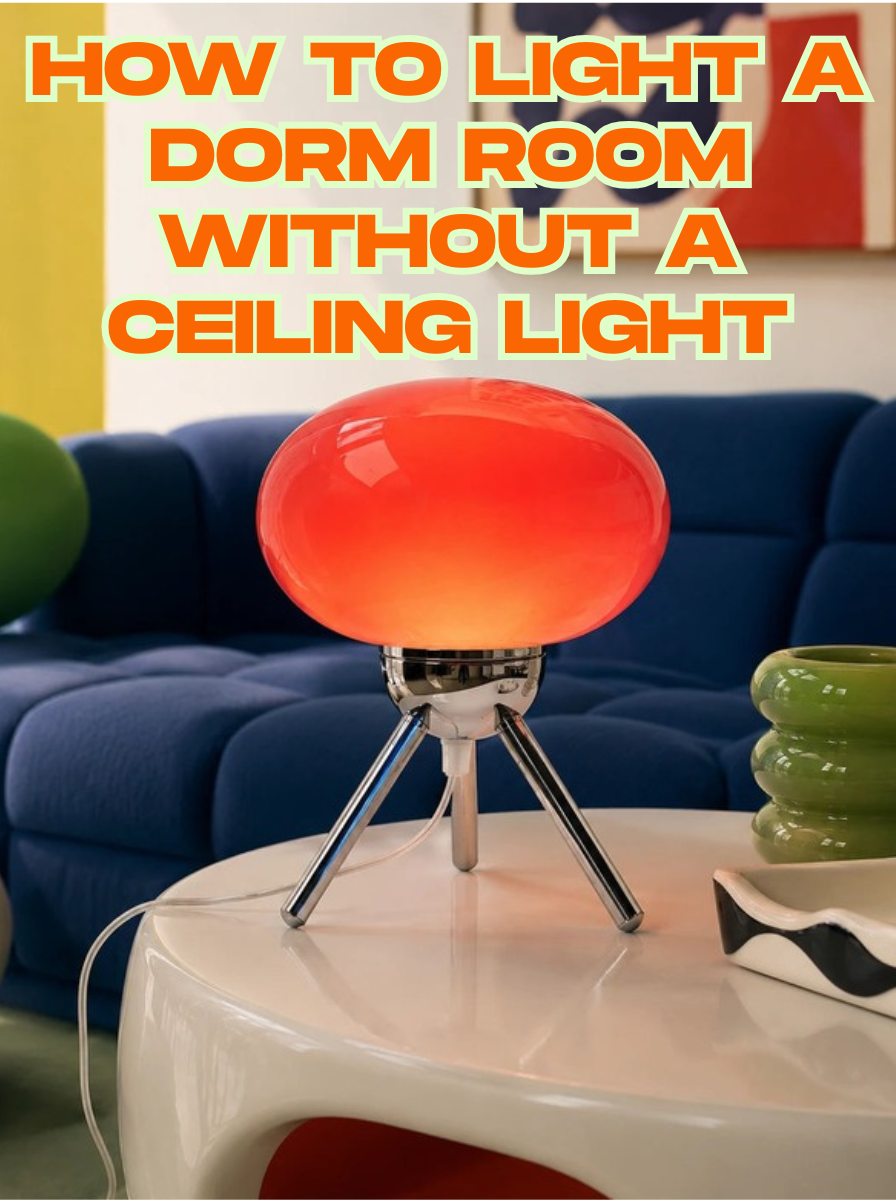
Move-in day ends the same way in most dorms: it's 9 PM, the ceiling has either one humming fluorescent tube or nothing at all, and the room you'll live in for nine months looks like a waiting room. The fix needs zero wiring and zero landlord conversations: light the room in three zones — one cool, focused light where you work, one warm, low light where you wind down, and one small light for the path between them. Two bulb temperatures do most of the work: 5000K at the desk and mirror, 2700K everywhere else. The fixtures are just delivery vehicles for those two numbers.
How to light a dorm room without a ceiling light: the 3-zone rule
Replace the missing ceiling fixture with three smaller lights, each doing one job: a task zone (desk and mirror), a wind-down zone (bed or reading corner), and a path zone (the strip of floor you cross at 2 AM).
Lighting guides like Apartment Therapy's no-overhead-light roundup land on the same count designers use: three to four separate sources make a room feel lit on purpose instead of dim. And more brightness is not the goal. In a four-country study of 988 office workers, mood bottomed out when lighting felt much too dark, peaked when it felt "just right," and declined again when it tipped into too bright (Küller et al., 2006, Ergonomics). A dorm doesn't need more light — it needs the right light in three specific places.
What color temperature should dorm lighting be?
Two numbers cover the whole room: 5000K — cool, blue-white, focused — wherever you need to see clearly, and 2700K — warm amber — everywhere you want your shoulders to drop.
Kelvin ratings are printed on every bulb box: 2700K is the color of a lamp at golden hour, 5000K is overcast daylight. Keeping them in separate zones isn't an aesthetic rule, it's physiology: Harvard's sleep-medicine guidance notes that cooler, bluer light in the evening suppresses melatonin more powerfully than warm light, which is why the standard sleep-hygiene advice is dim, warm light below eye level after dark. Research suggests the effect, not decor magic — we unpack the why in our room-fatigue explainer. The practical version: run the 5000K bulb at the mirror where you actually need color accuracy, and 2700K in every lamp you'll see after sunset.

This is also the one spec to check before buying any lamp: the socket. A standard E26 socket that ships without a bulb — like our tripod mushroom lamp, 55 cm (22 in) tall with a 35 cm (14 in) cap, about a vinyl record across — means you pick the Kelvin, not the manufacturer. "Warm glow" appears 21 times across our five-star reviews (our count, August 2026) — buyers describe the wind-down zone before we do. One of them, Alden, put it in one line: "the glass globe on this tripod base gives off such a warm glow that makes my bedroom feel really cozy."

The silhouette we mean: Tripod Mushroom Lamp
The wind-down zone on three legs — needs a surface at least 40 cm (16 in) wide, or the floor of a dead corner.
See itWhat desk lighting do you need for studying without harsh overhead light?
One focused 5000K source aimed at the work surface — and the best version of it isn't decor at all.
A plain hardware-store clamp lamp (usually around $15) grips a shelf or bed frame, aims wherever the textbook is, and takes the same E26 bulbs as everything else. It will out-study any accent lamp, including ours. We already ran the budget math in our under-$50 desk setup guide, and the verdict stands: on a tight budget, the lamp is the thing you buy last, after the bulb situation is fixed.
Our own review base keeps this section honest. The line that recurs in our lamp reviews is: "it's definitely more of a small accent lamp than a main light." That reviewer is right — and it's the single most useful thing to know before buying any sculptural lamp, from anyone. Accent lamps are the 2700K wind-down layer. Asking one to be your study light is how lighting purchases end up in the return pile.
How do you add light where there's no outlet?
Go USB-rechargeable, and mount with adhesive — dorm walls forgive stickers, not screws.
Dorm outlet math is unforgiving: two people, one power strip, and the spots that need light most — the closet, the shelf above the desk, the wall by the door — almost never have a plug nearby. Fear of mounting damage is real too: mounting-anxiety language shows up 24 times across the 700 reviews on our store (our count, August 2026). Rechargeable adhesive-mount fixtures exist for exactly that combination.

A rechargeable bar like our motion-sensor cordless bar light — 19.9 × 6.4 cm (8 × 3 in), about a phone laid on its side, 180 g (6.3 oz) — sticks under a shelf with adhesive strips and switches between always-on and walk-past motion mode, which is the path zone handled.

The no-outlet fix: Motion-Sensor Cordless Bar Light
USB-rechargeable, adhesive-mounted, phone-sized — the 2 AM path zone without a single cable.
See itOne logistics note, once: everything in our store ships free to the US and Canada with duties included, and every piece is quality-checked before dispatch.

For the blank wall itself, a backlit print such as our poster night light — A3-sized at 31 × 42 cm (12 × 17 in), 430 g, hung from corner grommets on removable hooks, powered by one USB cord — turns wall decor into the evening layer without any wiring, though it's ambient only and won't light a textbook.
What if your lighting budget is basically zero?
Change the bulb, move the lamps, use the mirror. All three are free or close to it.
- Swap the bulb you already own to 2700K. A warm LED bulb costs about the price of a coffee, fits the desk lamp you brought from home, and changes the entire mood of the room at 9 PM.
- Turn the desk lamp around after dark. Aim it at the wall instead of the desk — bounced light is instant ambient, and it's the same trick uplighter floor lamps charge real money for.
- Put the mirror opposite the window. It doubles your daylight for free, and a shelf placed below eye level gives any small lamp a stage — the same fit logic as our dorm desk fit guide.
What lighting should you skip in a dorm?
Anything with real heat, an open flame, or wiring — and that last category includes two products we sell.
Halogen lamps and candles are usually banned outright. Brown University's restricted-items list prohibits halogen torchière and desk lamps and all candles in residence halls, and most US housing policies read the same — check yours before buying anything that gets hot.

Skip hardwired fixtures entirely — including ours. Both wall sconces we sell, like the resin wall sconce, wire into a wall switch — right for your first apartment, wrong for a dorm, and no product photo will tell you that as plainly as the spec sheet does.
Don't make string lights the whole plan. They're allowed at most schools if UL-listed (Brown's policy says exactly that), and they're a fair budget ambient layer — but they're a glow, not a light. You still need the 5000K task zone or you'll be reading by fairy light in October.
FAQ
Are string lights enough to light a dorm room?
No. String lights are an ambient accent — roughly the dimmest layer in the room. They work as the wind-down zone's supporting cast, but you still need one focused 5000K task light at the desk and something warm at eye level for evenings. Check that any set is UL-listed; most university housing policies require it.
What's the best bulb color for studying and for sleep?
Use 5000K (cool daylight) for the desk and mirror, and 2700K (warm amber) for every lamp you see after sunset. Sleep-medicine guidance links cooler, bluer evening light to stronger melatonin suppression, so the warm bulb is the one that should own your night.
Are halogen lamps allowed in dorms?
Usually not. Brown University's residence-hall policy bans halogen torchière and desk lamps outright as fire hazards, and most US universities publish similar restricted-items lists. LED versions of the same shapes are the safe swap.
How many light sources does a dorm room need?
Three to four, matching the three zones: one task light (desk or mirror), one or two warm ambient lights (bed corner, shelf), and one small path light. That's the count professional guides converge on for rooms with no overhead lighting.
That's the whole answer to how to light a dorm room without a ceiling light: two bulb temperatures, three zones, nothing wired. The 9 PM test tells you whether it's working — if the only choice is "big light or darkness," the room fails; with the zones in place it has a work mode, an evening, and a way to cross the floor at 2 AM without waking anyone. If you add one bought piece, make it the warm layer (that's the job our accent lighting collection was assembled around) — but the bulb swap comes first, and it costs less than lunch.
Decorate your mood.
Not sure which vibe your room is missing? The quiz takes 2 minutes.
Find your vibe →
Share:
How to Hang a Wall Clock Without Drilling (Real Weight Math Included)
Your Wall Isn't Empty. Your Art Is Just Too Small (A Wall Art Size Guide by Furniture Width)