

The Mood Files is our recurring series on what environmental-psychology research actually says about rooms and mood — with the hedges and limits left in.
It's 9 PM on a Tuesday. You've been home for an hour, the big light is on, and the room you pay rent for somehow feels like a waiting area you're stuck in. Nothing is wrong, exactly. It's just draining.
A room usually makes you tired for four reasons researchers can measure: lighting that fights the hour, a color-starved visual field, clutter your brain keeps re-scanning, and a space with nothing of you in it. Each has a fix that costs less than repainting, and most start with a single corner.
Why does my room make me tired?
Because a room isn't a neutral backdrop — it's a stream of low-grade visual input your body keeps responding to all evening. If you've ever typed "why does my room make me tired" into a search bar at midnight, most results point at stuffy air and bad sleep. Fair: crack the window, fix the sleep. But the visual layer matters too, and it's the part decor can actually reach — the temperature of your light, where your eyes land, how much unfinished business sits in view, and whether anything in the room is really yours. The four sections below take those one at a time, studies attached.
Can a beige room actually affect your mood?
Modestly, yes — and honesty first: nobody has measured dopamine spiking at the sight of a checkerboard rug. "Dopamine decor" is a cultural name, not a clinical one. What researchers have measured is color and mood. In a cross-cultural study of 988 office workers in four countries published in Ergonomics (Küller et al., 2006), people in more colorful indoor environments reported better moods than people in drab ones, across seasons and latitudes. The effect isn't magic; it's measurable, and it's modest.
Color researchers also call it context-dependent (Elliot & Maier's "color in context" work): the same saturated red that wakes up a living room would wear a bedroom out. So the move isn't more color everywhere — it's one saturated thing per sightline, deliberately placed. We covered the trend side in our dopamine decor explainer; the practical version fits in a sentence: find the spot your eyes hit between tasks and give it one strong color. A slim arch-shaped ceramic vase in tangerine fills a bookshelf gap for under $30 and does exactly that job. When the color is chosen instead of accumulated, the room reads intentional — and your eyes finally get somewhere worth landing.
Does clutter really drain your energy?
This is the most direct research of the four. UCLA researchers followed 60 dual-income couples (Saxbe & Repetti, Personality and Social Psychology Bulletin, 2010) and found that how women talked about their homes tracked with their stress hormones across the day: those who described their space as cluttered or unfinished showed flatter cortisol slopes — a pattern associated with poorer stress recovery — while those who described it as restorative recovered better. It's correlational, so hold it loosely. But it rhymes with a 2016 study in the Journal of Environmental Psychology ("The dark side of home," Roster et al.): more clutter, weaker sense of home, lower reported life satisfaction.
The order of operations matters, though: subtract before you organize. If a surface is covered in things you don't actually want, a container for them is just denser clutter. Clear first; then give the survivors — pens, cords, chargers — a closed home so the desk stops broadcasting to-dos at you. A set of stackable modular storage boxes in a bold primary color turns that chore into decor instead of admin.

The felt difference arrives fast: you glance at the desk at 10 PM and it's simply done. Nothing on it is asking you for anything.
What lighting makes a room less tiring at night?
Warm, low, and layered. Harvard's sleep guidance is blunt about the mechanism: light of any kind suppresses melatonin at night, and blue-heavy light does it most powerfully — which is why the "daylight" bulb that serves you at noon works against you at 10 PM. The practical translation: after dinner, let the overhead light go dark and run two or three small pools of warm light (around 2,700K, below the roughly 4,000K range flagged in evening-light research) at or below eye level.

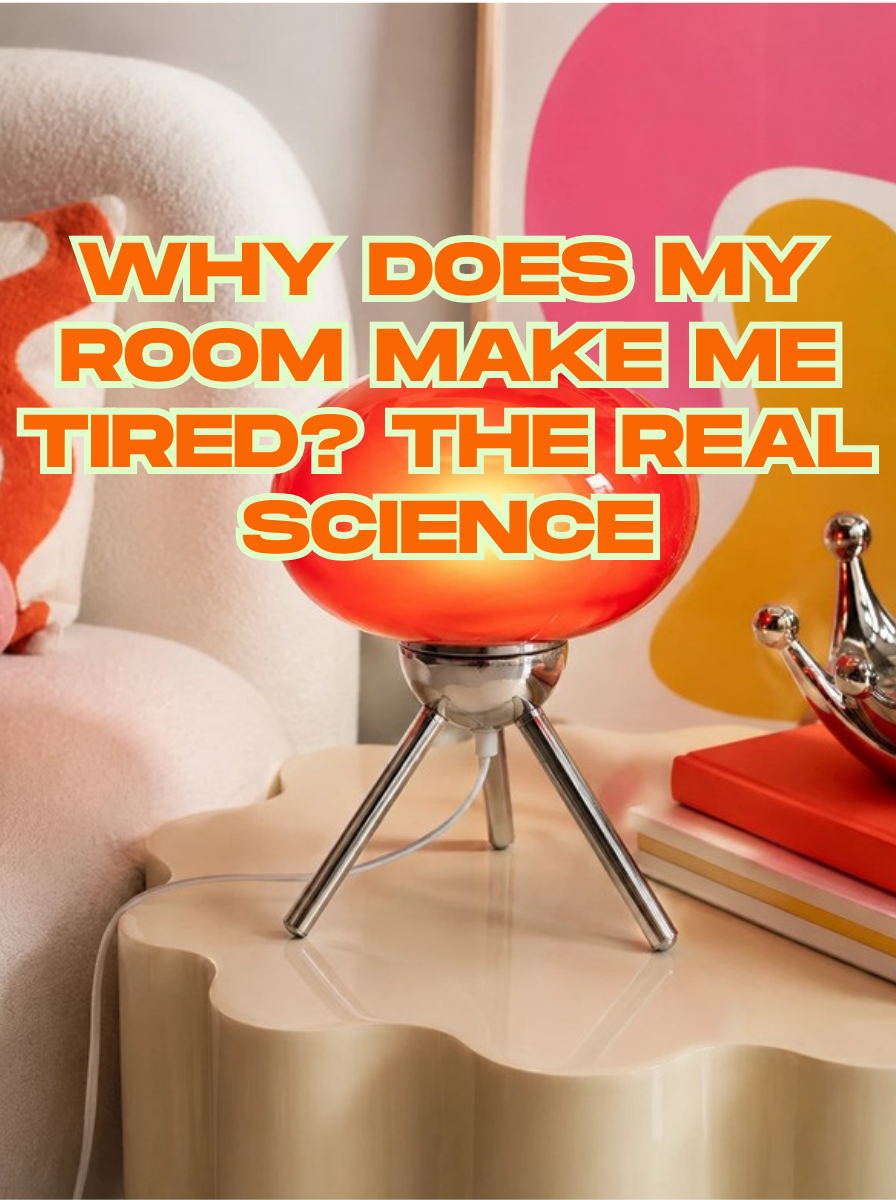
This is where our own data earns its place in the series. Across the 294 five-star reviews in our store (of 490 total, re-pulled July 18, 2026), "warm glow" appears 21 times and "cozy" 11 — buyers describe lighting upgrades in mood words, almost never in watt counts. A tripod mushroom lamp beside the chair you actually sit in puts that warm pool at seated eye level, and its standard E26 socket means you choose the bulb — and the color temperature — yourself. More silhouettes live in our lighting collection if mushrooms aren't your shape.
The silhouette we mean

Tripod Mushroom Lamp
"the glass globe on this tripod base gives off such a warm glow that makes my bedroom feel really cozy." — Alden, verified buyer
See itOne honest expectation check, straight from our four-star reviews: "it's definitely more of a small accent piece," as one buyer, Cyril, wrote about one of our mushroom lamps. He's right. Accent lamps are the wind-down layer, not the ceiling light, and ours won't illuminate a whole room — no accent lamp will. Check dimensions before buying any table lamp, too: this one's cap is 35 cm across and wants a surface at least 40 cm wide. Get the layer right and you meet the 9 PM version of your room: dim, amber, and suddenly the place you'd rather be than your phone.
Does decorating your room actually do anything?
In controlled experiments, yes — and who does the decorating matters more than what gets bought. Across two experiments with 159 participants (Knight & Haslam, Journal of Experimental Psychology: Applied, 2010), offices enriched with art and plants beat identical lean ones on well-being and productivity — and both climbed again when people arranged the space themselves. The enrichment wasn't decoration; it was agency.
That's the strongest argument against leaving a room in its move-in state, and it doesn't require a drill — renters can do all of it with damage-free methods. It also explains why finish-it-yourself pieces punch above their weight: a paint-your-own glass bottle lamp is agency in a box, and the version that ends up on your nightstand exists nowhere else. A room with your fingerprints on it stops feeling like a hotel you're tired in and starts feeling like a place that's on your side.
What should you skip when fixing a tiring room?
- Repainting, if you rent. Color through objects is reversible, cheaper, and — per the context-dependence caveat above — easy to correct when a color turns out to be too much.
- "Daylight" 5,000K+ bulbs in living spaces. Keep cool light for a task corner if you need one; evenings want warm.
- Buying storage before subtracting. Organizers full of things you don't want are clutter with a lid.
- The seventh throw pillow. The clutter research cuts both ways: saturation beats accumulation. One strong piece per zone, then stop.
Whatever you end up changing — with our pieces or anyone else's — everything we ship is free to the US and Canada; details on our shipping policy page. Our desk-side takes on the workspace version of this live in our cozy home office guide.
FAQ: rooms, color, and feeling tired
Why do I feel tired in my room even after a full night's sleep?
Check the non-decor layer first: ventilation, daytime natural light, screen habits. If the heaviness follows you everywhere — not just one room — that's a question for a health professional, not a decor blog. If it really is the one room, audit its light temperature, clutter level, and color using the four causes above; most people find two of the four apply.
Does dopamine decor actually release dopamine?
No study shows decor triggering dopamine release — the name is borrowed from fashion's "dopamine dressing," itself a loose borrow from lab research on clothing and cognition. What is documented: color measurably shifts self-reported mood (Küller et al., 2006, 988 workers), and personalizing a space improved well-being in controlled experiments (Knight & Haslam, 2010). Real effects, modest sizes, honest label.
What color light is best for evenings?
Warm white around 2,700K, positioned at or below eye level. Evening light in the bluer range above roughly 4,000K suppresses melatonin most strongly, per Harvard Health's sleep guidance, so save cool bulbs for daytime task corners. Dim beats bright, and lamp-height beats overhead.
How much color does one room need?
Less than Pinterest suggests: one saturated anchor per sightline — a vase, a lamp, one bold frame. The clutter research is the guardrail: when every surface is a statement, the room starts costing energy again. Curated, not cluttered.
Start tonight with one corner: overhead light off, one warm lamp on, one surface cleared, one object you chose in view. Then sit in it and notice what your shoulders do.
Decorate your mood.
Not sure which of the four fixes your room needs first? The vibe quiz takes two minutes and points you at the one that will land.
Take the vibe quiz
Share:
Quirky Bathroom Accessories That Give a Rental Personality (Not the Gag-Gift Look)
Aesthetic Desk Organization That Survives an Actual Work Week