 Menu
Menu

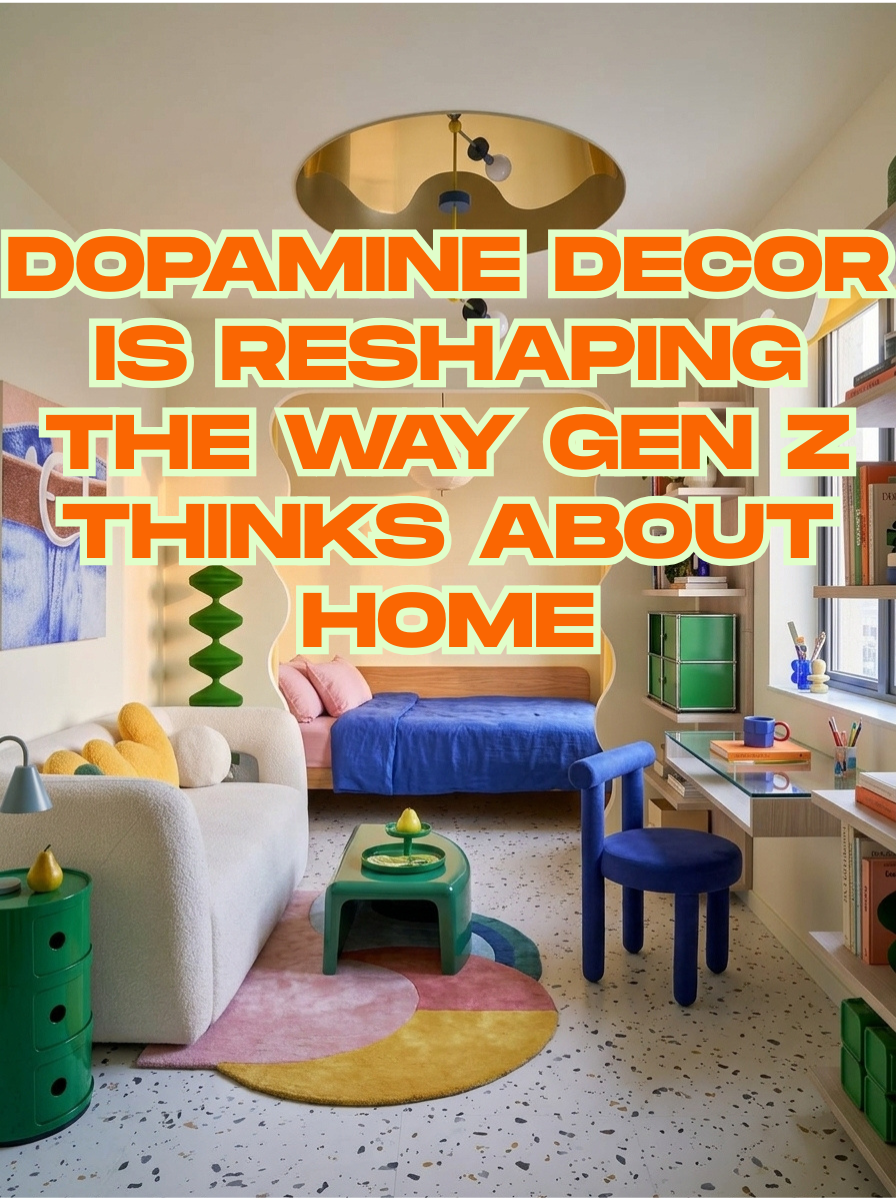
Dopamine decor isn't a Pinterest phase. It's a full-scale shift in what an entire generation expects from the spaces they live in — and in 2026, it's accelerating.
The movement, built on the premise that bold color and joyful objects actively improve mood, has moved well past early-adopter territory. It's now the dominant aesthetic language of Gen Z apartment living, driving some of the most-saved content on Pinterest and influencing what's actually selling in the home goods market. What started as a counterculture reaction to beige minimalism has become, quietly and definitively, the new mainstream.
From Hashtag to Movement: The Origin Story
Dopamine decor emerged around 2021 as a direct extension of "dopamine dressing" — the fashion theory that wearing saturated, high-chroma color produces measurable mood effects. Interior designers and Gen Z creators applied the same logic to living spaces, and the aesthetic spread across TikTok and Pinterest almost immediately.
The core claim is simple: your home should actively make you feel something. Not "calm." Not "neutral." Good. The movement rejects the aspirational minimalism of the 2010s — the staged grey-and-white aesthetic that dominated HGTV and design media — and replaces it with unapologetic color, personality-driven objects, and the conviction that a space should look like the person who lives in it. Checkerboard rugs, neon signs, fruit-shaped lamps, bold gallery walls, and saturated textiles aren't decorating mistakes in this framework. They're the point.
What makes dopamine decor distinct from earlier maximalism movements is its emotional intentionality. This isn't accumulation for its own sake. Every object is chosen for the feeling it produces — which is why the aesthetic draws so heavily from '80s Memphis postmodernism, '70s retro kitsch, and '90s nostalgia. These were eras of deliberate sensory excess, and dopamine decor treats them as source material rather than history.
Why 2026 Is Dopamine Decor's Defining Year
Three forces have converged to push this aesthetic from a niche corner of the internet into a dominant cultural current.
The remote-work permanence effect. The normalization of working from home — still the reality for a significant portion of Gen Z's employed demographic — has fundamentally changed how people relate to their apartments. A space that used to serve primarily as a sleeping location is now also a workplace, a social backdrop, and a daily mood environment. The stakes of what a home looks, feels, and functions like have risen sharply. Dopamine decor is, among other things, a direct response to spending a lot of time in one place and wanting that place to feel worth inhabiting.
Pinterest's discovery flywheel. Pinterest confirmed 600 million monthly active users for 2026, with 70% of users more likely to purchase after discovering content on the platform. Dopamine decor generates outsized saves because the aesthetic is inherently visual and inherently shareable — every well-composed dopamine decor image is already a mood board. The platform's algorithm rewards that engagement, which drives more creators to produce dopamine content, which drives more saves, which drives more purchase intent. It's a self-reinforcing loop that's still accelerating.
Gen Z's explicit rejection of "aspirational" design. This is the generation that grew up watching homes get flipped into generic grey-and-white rental units and decided that wasn't the aspiration. Personalization, specificity, and visible personality aren't the decorating equivalent of casual Friday — they're the baseline expectation. Dopamine decor doesn't ask permission to be noticed. That's precisely the point.
In 2026, the trend is also absorbing energy from adjacent Pinterest Predicts movements: "FunHaus" (circus-inspired bold stripes, chromatic drama, deliberate playfulness) and "Extra Celestial" (holographic accents, opalescent surfaces) are both mapping onto dopamine decor's core vocabulary. The aesthetic isn't narrowing — it's expanding by absorbing whatever visual language shares its emotional register.
The Objects Leading the Charge
What's actually driving dopamine decor's momentum in 2026 isn't a single product category — it's the mainstreaming of the idea that every object in a room is an aesthetic decision. Functional items aren't exempt from the movement. They're being recruited into it.
Lighting is the most visible front. The statement fixture has emerged as one of dopamine decor's most contested and expressive pieces precisely because it combines function with sculptural presence. A Tangerine Donut Wall Lamp — a 30 cm ring of warm light that mounts flat to the wall and dims by touch through three color temperatures — isn't doing the work of "illuminating a room." It's doing the work of defining it. Tangerine and burnt orange have become two of the movement's most reliable signature colors because they're warm enough to feel joyful without veering into aggression. Mounted above a dining nook or a bedside, this piece functions as the kind of color anchor that makes everything else in the room read as intentional.
Wall fixtures are undergoing a similar evolution. The Corner-Mounted Wall Clock — a 26.8 × 25 cm acrylic and resin timepiece in red, designed to mount at room corners so both faces are visible from perpendicular angles — is a direct expression of dopamine decor's insistence on treating functional objects as sculptural ones. The choice to manufacture a clock in red acrylic isn't a neutral design decision. It's a commitment to the idea that a clock should do something to a room beyond telling time. The corner placement adds a spatial layer of unexpectedness that the movement prizes: the object appears where you don't expect it, and the red reads as intentional the moment you see it.
The movement is also reshaping what objects are allowed to be decorative at all. Vases have historically occupied a supporting role in interior design — vessels for flowers, filler for shelves. Dopamine decor has promoted them. A Stacked Silhouette Glass Vase — available in purple, green, or black, its stacked volumes catching the light in a figure-like silhouette — isn't background. The sculptural form and saturated colorway are foregrounded as the point. No flowers required. The object itself is the gesture, and the choice of purple or acid green communicates exactly the same chromatic intention as a bold pillow or a painted wall. Sculptural glass at this scale also fits the broader Gen Z value set: low-maintenance, functional, aesthetically driven, and apartment-scale.
The dopamine decor frame has also extended to objects associated with daily ritual. The Handcrafted Ceramic Teapot Set — 1200ml teapot and two 300ml cups, each with a soft glaze finish — represents the quieter register of the movement. Dopamine decor at its most sophisticated isn't only about visual loudness; it's about the accumulated quality of small sensory moments. A handcrafted object used every morning, chosen deliberately rather than defaulted into, carries the same underlying logic as a neon sign: both are refusals of the anonymous and the generic. The ceramic's soft glaze and handmade character make it tactile in a way mass-produced tableware isn't — and in a design movement that's fundamentally about how things make you feel, texture is never beside the point.
The Palette Defining the Moment
Color is dopamine decor's first language, and 2026 has clarified which palettes are resonating most.
Barbie pink and acid green remain the movement's most-saved combination — high contrast, Y2K-adjacent, and aggressively shareable. Tomato red and butter yellow occupy the warmer end of the spectrum, evoking '70s kitsch without tipping into earth tones. Electric blue and hot magenta are the Memphis-inflected option: high contrast, geometric, more architectural in the way they define a space.
Tangerine and orange — carried through objects like that donut wall lamp — are having a particular moment because they bridge the warmth of the '70s retro palette with the saturation level dopamine decor requires. Orange works in spaces that are otherwise neutral without overpowering them, which makes it a practical entry point for decorators who are moving toward the aesthetic gradually.
The emerging color story for 2026 layers holographic and iridescent accents into already-bold palettes — a direct cross-pollination from the Extra Celestial trend. Acid green pillows with a holographic throw. A red sculptural vase beside a mirrored disco ball. The movement is developing a visual complexity that goes beyond "bright colors" into genuinely layered chromatic composition.
Where Dopamine Decor Goes From Here
Dopamine decor is entering a maturation phase, and maturation in design movements almost always means fragmentation into more specific sub-aesthetics.
Retro-dopamine is the most developed of these: specifically '70s and '80s source material filtered through the movement's color logic. Memphis patterns, wrought iron fixtures with geometric profiles, sculptural glass objects — these reference design eras with documented aesthetic philosophies rather than the general "bold and colorful" category. The donut wall lamp and the corner clock both operate in this register.
Functional maximalism is the small-space adaptation of dopamine decor that's gaining traction as more of the movement's core audience (Gen Z renters, first apartments) applies the aesthetic to studio units and compact layouts. The logic: fewer objects, but each one doing more aesthetic work per square foot. A 30 cm sculptural vase on a windowsill. A corner-mounted clock that uses vertical and corner space rather than wall real estate. A wall lamp that defines a zone without touching an outlet or a table surface. The objects are chosen for maximum visual impact within minimum footprint.
Dopamine ritual objects — everyday-use items chosen with the same intentionality applied to statement furniture — are the movement's quietest and potentially most durable evolution. This is where the handcrafted teapot set lives: not loud, but deeply deliberate. As dopamine decor matures past its most visually aggressive phase, this register may prove to be where the aesthetic finds its longest shelf life.
The brands that will define the next phase of this movement aren't the ones chasing the loudest possible iteration of the trend. They're the ones with catalogs deep enough to serve each of these sub-aesthetics as they develop — and the design literacy to speak to all of them coherently.
FAQ
What is dopamine decor? Dopamine decor is an interior design movement built on the premise that bold color, maximalist personalization, and joyful objects actively improve mood. The term emerged around 2021, adapted from "dopamine dressing" in fashion. Key hallmarks include saturated color palettes (acid green, Barbie pink, tomato red, tangerine), checkerboard and smiley motifs, novelty and sculptural objects, neon signs, and layered textiles. The movement treats functional objects — clocks, lighting, vases, tableware — as aesthetic statements rather than neutral utilities.
Is dopamine decor the same as maximalism? Dopamine decor is a subset of maximalism but with a specific emotional emphasis. Maximalism is the broad philosophy of visual abundance — more textures, more objects, more color. Dopamine decor is mood-first maximalism: objects are chosen specifically for the positive emotional response they produce. A heavily layered Victorian room is maximalist; a red corner clock above an acid-green gallery wall is dopamine decor. The distinction is intentionality and emotional target.
What colors define dopamine decor in 2026? The core palette includes Barbie pink, acid green, tomato red, butter yellow, tangerine, electric blue, and hot magenta. Orange and burnt orange are having a strong moment in 2026 as warm-spectrum representatives of the movement. The emerging 2026 update layers holographic and opalescent accents into already-bold color combinations, a cross-pollination from the "Extra Celestial" aesthetic trend.
Can dopamine decor work in a small apartment? Yes — and 2026's "functional maximalism" sub-aesthetic was developed specifically for compact spaces. The approach prioritizes fewer, higher-impact objects over full visual saturation: a sculptural pendant light to define a zone, a corner-mounted clock that uses architectural space efficiently, a tall sculptural vase on a windowsill ledge. The object does the work; the room doesn't need to be large.
Where does dopamine decor come from aesthetically? Dopamine decor draws from three primary sources: Memphis postmodernism (the Italian design movement founded by Ettore Sottsass in 1981, known for bold geometry, squiggles, and primary-plus-pastel palettes), '70s retro kitsch (earth-warm saturated colors, sculptural forms, ironic nostalgia), and '90s nostalgia (pattern clashing, novelty objects, deliberate anti-minimalism). The Gen Z iteration filters these through a contemporary lens that's part ironic, part completely earnest.
Share:
Gen Z Kitchen and Dining Decor: Tips and Ideas for 2026
Cozy Home Office Ideas: How to Make a Small Workspace Feel Warm