

You moved the furniture, bought the colorful stuff, and you still can't tell whether it did anything.
Short answer: research suggests parts of dopamine decor hold up and parts don't. No study shows decor releasing dopamine. What researchers have measured is that color, clutter levels, and above all whether you chose the room yourself track with how people feel in it. Decorate for that last one first.
This is The Mood Files, where we read the studies behind the aesthetic instead of the captions. If you want the origin story first, we covered what dopamine decor is and why Gen Z adopted it separately. This post is only about whether it delivers.
Does dopamine decor really release dopamine?
No. Nobody has measured dopamine spiking at the sight of a checkerboard rug, and any page telling you otherwise is describing a metaphor as if it were a measurement.
The real evidence is more interesting than the fake version. Nobody has studied "dopamine decor" as a category, but researchers have studied color and mood, clutter and well-being, personalization, and contact with plants — which covers most of what the trend asks you to do.
Some context for why this feels urgent: in the American Psychological Association's 2023 Stress in America survey, adults aged 18–34 reported average stress of 6.0 out of 10 versus 3.4 for adults 65 and older, and 58% said their stress felt "completely overwhelming" most days. That isn't a diagnosis, and a room isn't a treatment. It's a reason the one space you fully control is worth getting right.
Can adding color to a room actually change your mood?
Modestly, yes — and the effect is about how the room reads to you, not about specific colors having fixed powers.
The strongest study here is Küller, Ballal, Laike, Mikellides and Tonello's 2006 cross-cultural study in Ergonomics (volume 49, pages 1496–1507), which followed 988 workers across countries and seasons. Colour and light did influence mood. The wrinkle that never makes it into trend articles: mood tracked with how the lighting was experienced, not with measured illuminance. Too dark was worst, "just right" was best, too bright dropped it again.
The practical read: saturation beats accumulation. One object your eye wants to land on does more than nine competing ones. Pick a color that survives your real light — check it at 9 PM under your lamp, not at noon — and give it a clear spot instead of scattering it. A slim ceramic vase in a saturated colorway is the cheapest version of that test: one bright note at eye level, movable for a week before you commit to anything larger.

Does decluttering actually reduce stress?
The research points one direction: clutter is associated with a weaker sense of home and lower well-being, which makes "more color, fewer objects" a defensible rule rather than a taste preference.
Roster, Ferrari and Jurkat's "The dark side of home" (Journal of Environmental Psychology, 2016, volume 46, pages 32–41) surveyed people across the U.S. and Canada and found possession clutter had a strong negative relationship with both psychological sense of home and perceived well-being. It's correlational — an association, not a lever. But it should discipline anyone selling maximalism, us included: dopamine decor done badly is visual noise, and noise is what people describe as draining.
The move that works is subtraction before addition. Clear the surface completely, put back only what earns its spot, and give the rest a closed home instead of a pile — a set of stackable desk drawers does more for a small room than another shelf of objects. More on that in our guide to aesthetic desk organization.
Does decorating your own space do anything for your mental health?
This is the strongest finding in the whole conversation, and it's about who chose the objects rather than what they are.
Knight and Haslam's 2010 experiments in the Journal of Experimental Psychology: Applied (volume 16, pages 158–172) put 159 people across two studies into offices that were either bare, decorated for them with plants and art, or decorated by them. Enriched offices beat bare ones: people were around 17% more productive. But people at desks they had arranged themselves were about 32% more productive than the bare condition, with no rise in errors. When experimenters came in afterwards and "improved" the workers' choices, the benefit disappeared.
That last part is the whole argument against copying a Pinterest room exactly. The measurable ingredient wasn't the art. It was the agency.
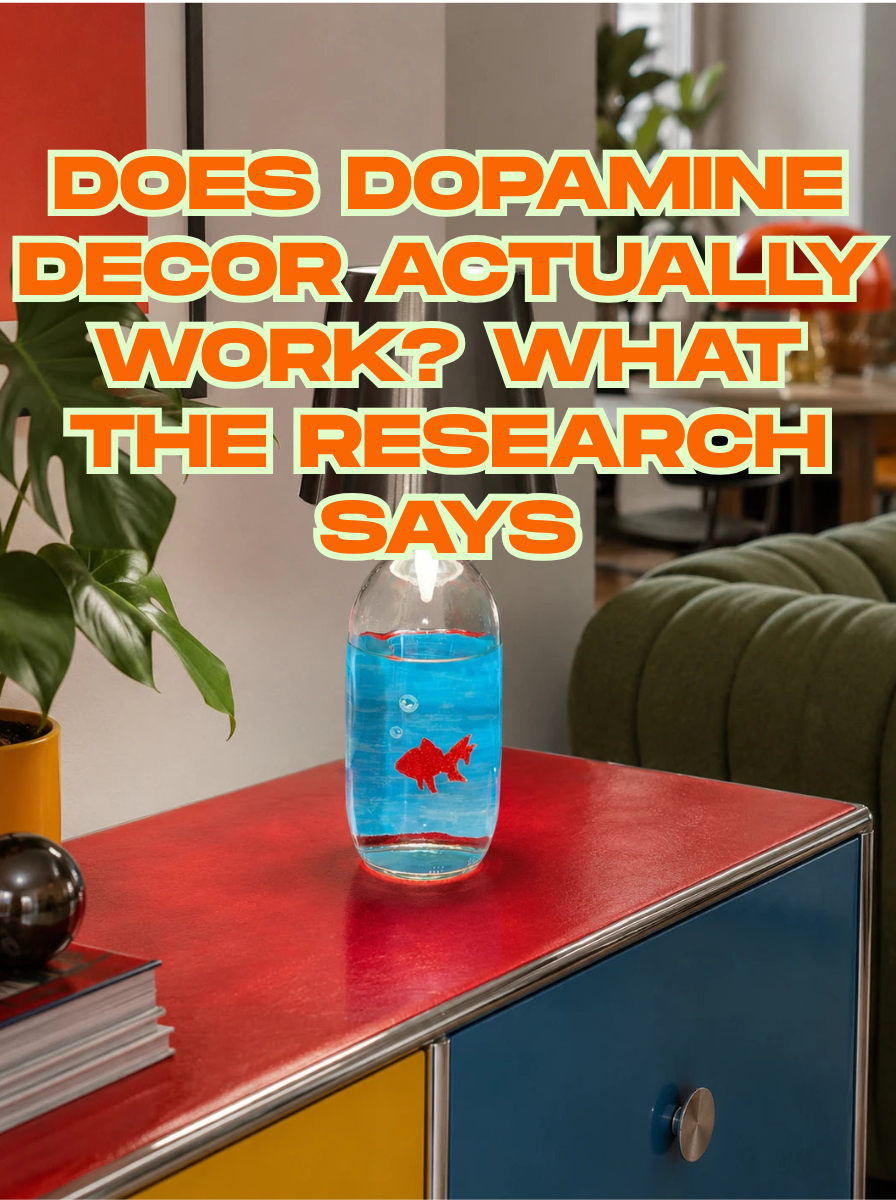
Which is a good reason to own one object you made a decision about — a piece you painted, arranged, or picked in a colorway nobody else you know has. A paintable glass bottle lamp that arrives blank with acrylic markers is the literal version: the room holds something that exists because you decided how it should look.

"i love how the lamp illuminates the bottle's glass, it creates the most relaxing atmosphere in my room at night." — Benjamin T., verified buyer, 5 stars

Do plants earn their spot, or is that just aesthetics?
They may earn it — but the study usually cited here is about tending a plant, not owning one. In a randomized crossover trial by Lee, Lee, Park and Miyazaki (Journal of Physiological Anthropology, 2015), participants who spent 15 minutes transplanting an indoor plant showed lower sympathetic nervous system activity and lower diastolic blood pressure than after 15 minutes of computer work: 65.26 mmHg versus 71.75. Hedge it hard — 24 participants, all young men, hands in soil rather than a pot across the room. If you want greenery to do more than fill a corner, put it where you'll touch it.
So, does dopamine decor actually work?
The question "does dopamine decor actually work" has two answers depending on which half you mean. The aesthetic's name is marketing. Its method is mostly supported: choosing objects deliberately, keeping surfaces clear, and using color in doses each have research behind them.
Here's our own evidence for why the framing matters. We re-parsed all 700 reviews on our store on 28 July 2026. Across the 457 five-star reviews, buyers reached for atmosphere words far more than clinical ones: "vibe" 42 times, "glow" 28, "cozy" 17, "my room" 11 — while "mood" appeared 4 times. Nobody wrote that a lamp fixed their brain chemistry. They wrote that a corner finally felt like something.
What dopamine decor advice should you ignore?
- Anything promising a neurotransmitter. If a page says color "releases dopamine" or "lowers cortisol," it's dressing a vibe in lab clothes.
- "More is more" as a starting point. The clutter research cuts against it. Maximalism is an editing discipline, not an accumulation strategy — get the room right with six objects before trying sixteen.
- The exact room you saved. Copying someone's setup piece for piece removes the one ingredient the strongest study measured. Steal the formula, not the shopping list.
One honest trade-off from our reviews rather than a spec sheet: many of the brightest pieces here are exactly as lightweight as they look. A buyer said of a vase, "it looks really modern and cool but the plastic is a bit lighter than i expected for the price," and another told us a bottle lamp was smaller than she'd pictured for a desk. Lightweight is useful in a rental you'll move out of. It also means checking dimensions before you fall for a photo.
The companion piece in this series covers why a room can leave you tired. Ours live in the dopamine decor collection, with free shipping across the US and Canada.
Frequently asked questions
Is dopamine decor backed by science?
Partly. No research covers "dopamine decor" as a category, and none shows decor releasing dopamine. There is research on what it asks you to do: color and mood (Küller et al., 2006), clutter and well-being (Roster et al., 2016), personalizing your space (Knight & Haslam, 2010). Treat those as modest, supportive findings, not guarantees.
What colors are best for a dopamine decor room?
There isn't a correct palette. The 2006 Ergonomics study found mood tracked with whether the light and colour felt right to the occupant, not with fixed color values. Pick colors that hold up in your evening light, and use fewer at higher saturation.
Can dopamine decor be overstimulating?
Yes, and that's a fair criticism rather than a reason to skip it. The clutter research suggests visual overload works against the feeling people are chasing. If a room feels busy rather than bright, remove objects before adding color.
What's the single change to make first?
Clear one surface completely, then put back exactly one object you chose yourself. That covers the two best-supported findings — less clutter, more agency — before you spend anything.
Decorate your mood.
Not sure which vibe is actually yours? The 2-minute quiz reads your space and tells you what it's missing.
Find your vibe →Written by the Retro Radius Team. Published 28 July 2026. Study links verified live on the publish date.
Share:
Aesthetic Desk Organization That Survives an Actual Work Week