 Menu

It's 11:40 PM. Your phone is at 4%, the charger cable just about reaches the floor, and your water glass is balanced on the edge of the mattress, because the gap between the bed and the wall is roughly the width of a shoebox.
If a nightstand won't fit, measure the gap before you buy anything. Under about 10 inches, go up the wall with a shallow shelf at mattress height. From about 12 to 16 inches, a narrow, see-through table fits. Either way, treat the light as a separate job: a lamp that doesn't need the surface frees up the whole surface.
Here's how to choose, by the inch, plus what to skip.
How much space do you actually need beside the bed?
About 12 inches of floor between the bed frame and the wall is the usual minimum for a real nightstand. UNFNSHED's small-space sizing guide puts it there, and says that under 10 inches you're in wall-shelf or mini-table territory (UNFNSHED). That's the gap you have left over after the walkway. Bedroom layout guides ask for 24 to 36 inches on the side of the bed you get in and out of, with 24 as the minimum and anything under 18 too tight (Mattress Stores Los Angeles).
So measure two things with the bed where it actually lives: the gap at the head of the bed, and the height from the floor to the top of your mattress, topper included.
- 0 to 10 inches: wall only. Shelf, ledge or nothing on the floor.
- 10 to 12 inches: a wall shelf, or a small stool if you can live with a narrow top.
- 12 to 16 inches: a narrow table, ideally one you can see through.
- Over 16 inches: you have room for a normal nightstand. The problem is probably what's on it.
What are the best nightstand alternatives for small bedrooms?
A wall shelf, a narrow see-through table, or a stool. Which one depends on the gap you just measured. Most nightstand alternatives for small bedrooms fall into those three, plus the headboard ledge if your bed has one. Most roundups list them as equal options. They aren't: each one only works in a certain gap, and the list above sorts them by it.
Whatever you pick, keep its top close to the mattress. Both guides cited above land in the same place: within about 2 inches of the mattress top, or up to 4 inches above it.

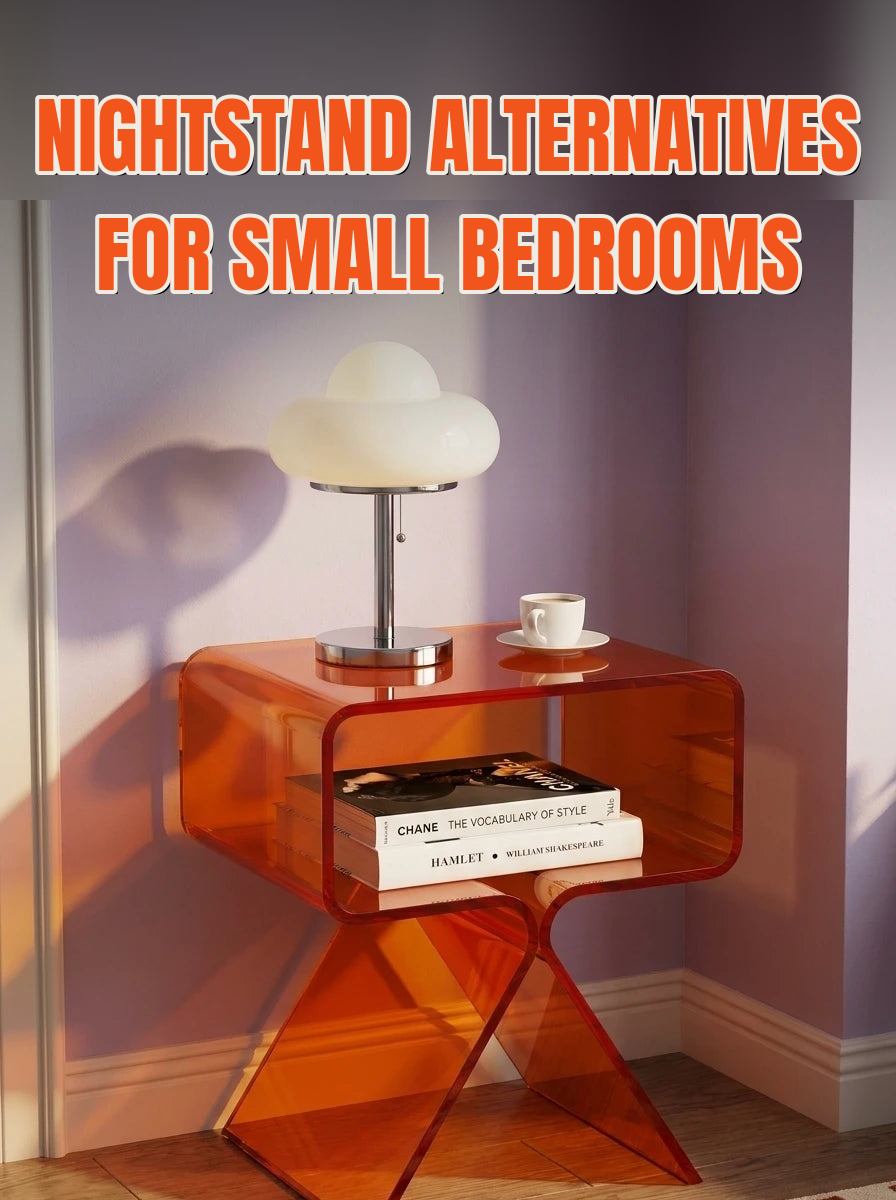
In a 16-inch gap, clear acrylic is the move, because you see the floor and wall through it and the corner stays visually open. A clear acrylic bedside table measures 40 x 30 x 55 cm (16 x 12 x 22 in), about the footprint of two sheets of printer paper side by side, and holds up to 10 kg (22 lb). One honest note: it stands on an X-shaped base, so it needs that full 16 inches of floor. And at 22 inches tall, it suits lower beds and platform frames better than a tall mattress stack.

How high should a bedside shelf be?
Level with the top of your mattress, or a hand's width above it. That keeps it inside the same within-2-to-4-inches zone as a nightstand and means you can reach it lying down without sitting up. Before drilling the second hole, lie down and reach for it.
Depth matters more than width. A 5-inch shelf holds a phone, glasses and a slim book. If you need a lamp and a mug up there too, you need the 12-inch table.

A lipped ledge is the better shape here, because the raised front edge catches a phone that slides when you set it down half-asleep. A tinted acrylic floating shelf is 40 x 12 cm (16 x 5 in), rated to 3 kg (6.6 lb), and mounts with screws into the wall, so check your lease before you drill.
Where do you put a lamp when there's no nightstand?
On the wall, clipped to the bed frame, or on a surface it can live on without crowding everything else. Light is where small bedside setups usually go wrong: a lamp eats half the surface, and its cord has to reach an outlet the bed is probably blocking. Solve it as its own job and the surface gets simpler.
The wall-first idea isn't just ours. In our own Pinterest account's weekly report for October 12, 2026, two of the three best-performing new pins were about this exact room:
| Pin | Impressions | Saves |
|---|---|---|
| "A narrow bedroom with no room for a nightstand? Use the walls" | 11,705 | 74 |
| "What if the nightstand clutter was the prettiest part of the bedroom?" | 9,232 | 176 |
Source: Retro Radius Pinterest analytics, weekly report dated 2026-10-12. One account's numbers, not a survey.
The clutter pin collected more than twice the saves on fewer views, which suggests people want the bedside surface to look good, not just to exist. That's the next section.
There's a real reason to get the color right, not just the spot. In a small lab study, researchers at the University of Basel gave 16 young men two hours of evening light at the same low brightness. Under cool 6,500K light, their melatonin rose about 30%. Under warm 3,000K light, it rose about 49% (Chellappa et al., 2011, PLoS ONE). One small study, about light rather than any lamp you can buy, but it matches standard advice: warm and low for the last hour. Our Mood Files post on why rooms feel cold at night goes deeper.

If your surface is the 12-inch table, a lamp with no cord solves the reach problem: you don't have to plan around an outlet. A cordless mushroom table lamp has a 15.5 cm (6 in) iron shade, stands 20.5 cm (8 in) tall, recharges over USB and dims down to a faint amber glow. It's a glow, not a reading light. Its shade is wider than a 5-inch ledge, so it belongs on the table, not the shelf.

If you actually read in bed, a basic clamp-on reading lamp from any hardware store is worth comparing: it grips the headboard, takes zero surface, and aims light at the page. The trade-off is a utilitarian look and a cord down the frame. Our guide to lighting a room without a ceiling light covers how to layer the two.
What should go on a bedside surface when space is tight?
Three things: your phone, something to drink, and one thing you'd miss. Everything else goes in a drawer or a basket on the floor. A National Sleep Foundation poll found 95% of people used an electronic device within an hour of bedtime at least a few nights a week, and people under 30 were the most likely to be on a phone (Harvard Health, on the 2011 Sleep in America poll). So plan for the charger first: run the cable along the frame and give the phone a fixed spot.
The limit is about calm, not just space. Research on homes has linked clutter with lower well-being and a weaker sense of home (Roster, Ferrari & Jurkat, 2016). That's a correlation from surveys, not proof a bare shelf will change your evening. But the last thing you see before lights out might as well be one object you like, not six you forgot to put away.
What's the $0 version?
Use what you already own. A dining chair or stool turned sideways, a stack of hardcover books with a tray on top, or a lidded box all work as a temporary nightstand. Live with it for a week and you'll learn what you actually reach for, which is the brief for whatever you buy next. For the height math in more detail, our side table height guide uses the same within-a-couple-of-inches logic.
What should you skip?
- A deep nightstand in a narrow gap. Small-space guides put usable depth at 12 to 14 inches; anything deeper eats the walkway. If you're turning sideways to get into bed, it's too big.
- Hardwired wall sconces in a rental. Many wall lamps, including several we sell, wire into the wall. That's an electrician and a landlord conversation. Pick a plug-in, cordless or clip-on light instead.
- Candles on a shelf by the bed. Too close to bedding, too easy to fall asleep next to.
- A shelf you can't reach lying down. If you sit up to use it, it's decor, not a nightstand.
If you want a whole-room fix, a bed with a storage headboard does the shelf's job without touching the wall; the trade-off is replacing the bed, which is a much bigger spend than a shelf. For the smaller pieces, browse our small-space furniture and side tables; US and Canada shipping is free, duties included (shipping policy). Start with the tape measure, though. Two numbers, the gap and the mattress height, decide most of it.
Frequently asked questions
What can I use instead of a nightstand?
A floating shelf at mattress height, a narrow side table, a stool, or a stack of hardcover books with a tray on top. Under about 10 inches of space beside the bed, use the wall. From about 12 inches, a slim table fits.
Can a bed go without a nightstand?
Yes. You need somewhere for a phone and a drink, and a light you can switch off lying down. A wall shelf plus a clip-on or cordless lamp covers all three without any floor space.
How wide should a nightstand be in a small bedroom?
Keep it no wider than the gap beside the bed, and about 12 to 16 inches is a common range for small rooms. Depth matters as much: a table much deeper than 14 inches starts eating the walkway.
Is one nightstand enough for a double bed?
Often, yes. Put the full nightstand on the side with more space, and a wall shelf or ledge on the tight side. The two don't need to match, as long as both tops sit near mattress height.
Decorate your mood.
Measured the gap but not sure what you want by the bed? Our two-minute vibe quiz narrows down the colors and shapes that fit your room.
Retro Radius Team
Share:
Should Throw Pillows Match the Rug?