 Menu
Menu

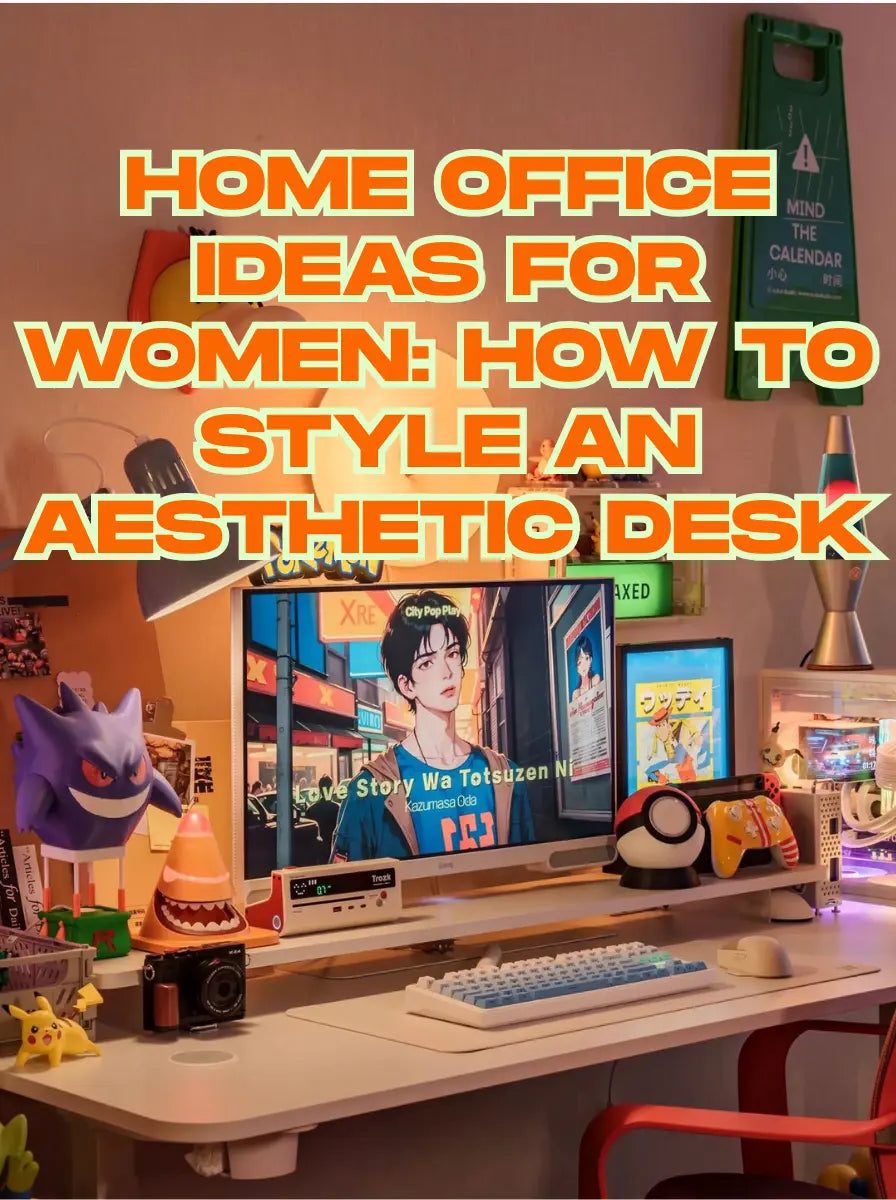
The most-searched home office ideas for women aren't about a bigger room or a standing desk — they're about a workspace that doubles as a styling surface. A desk that looks like it belongs to a person, not a server room. This guide is a roundup of desk-level moves that work whether you've got a full spare-room office, a corner of the bedroom, or a rented cubicle you're trying to make survivable. Every idea fits on a standard desktop and most cost under $60.
What defines an aesthetic desk setup?
An aesthetic desk setup is a workspace styled like a shelf you'd actually display — function and decoration in the same footprint. Instead of hiding the desk's contents in drawers, it puts the good-looking versions of everyday objects (the pen holder, the tray, the clock, the small shelf) out where they read as styling. The work-desk aesthetic that dominates Pinterest and TikTok shares a few traits: a vertical element to draw the eye up, soft or curved shapes instead of hard black rectangles, one or two warm metallic or ceramic finishes, and a tight, repeating color story. The result fits a cubicle as easily as a home office, because it's built on the desktop, not the room.
The reason this resonates as a "home office ideas for women" search isn't gendered taste — it's that this group is over-indexed on small, shared, or rented workspaces where the desk is the only thing you can fully control. So you style the eight square feet you own.
1. Build up before you build out
The first rule of a small desk: go vertical. A desktop shelf nearly doubles your usable surface and gives you a place to stage the things that make a desk feel personal — a couple of books spine-out, a tiny plant, a framed photo — above the working zone.

The curved wire desktop bookshelf does this with a soft-geometry frame that reads as sculpture rather than office supply. The looped wire silhouette is part of the contemporary "soft geometry" trend — curves and blobs replacing the hard right angles of corporate furniture — and it's the rare organizer you'd be happy to have in frame on a video call. On a cubicle desk, it's the single highest-impact upgrade: it lifts your monitor sightline, adds storage, and softens the whole partition.
2. Corral the small stuff in something worth displaying
Pens, sticky notes, charging cables, lip balm, the three highlighters you actually use — the small-object chaos is what makes a desk read as messy even when it's organized. The fix isn't a drawer; it's giving that stuff a home you'd be happy to look at.

Two pieces handle this. The ceramic flame desk organizer is a glazed pen-and-scissor holder with enough personality to be a desk object in its own right — the cartoon-flame shape is exactly the kind of small dopamine hit that the work-desk aesthetic is built on. For the flat clutter — keys, jewelry you take off to type, AirPods — a Nordic acrylic round tray creates a defined "drop zone" in translucent tinted acrylic so the catch-all has an edge instead of spreading across the whole desk. The styling principle: every loose object should have a designated vessel. A desk reads as intentional when nothing is just lying directly on the surface.

3. Add a mirror — for the light and the video calls
A small mirror near a desk pulls double duty: it bounces whatever natural light you have deeper into the room, and it gives you a two-second appearance check before a camera turns on. In a windowless cubicle or an interior room, a mirror is the cheapest way to fake daylight.

The daisy petal wall mirror does it with a scalloped floral silhouette that functions as wall art when you're not using it — the petal frame is decorative enough to anchor the space above a desk the way a piece of art would. Hang it where it can catch and throw light from a window or lamp, and angle it so your seated reflection lands in frame. It's the rare object that's genuinely useful and genuinely pretty, which is the whole brief for an aesthetic desk.
4. Make time visible (and not on your phone)
A real clock on the desk is an underrated work-desk-aesthetic move. It keeps you from picking up your phone to check the time — which always turns into a fifteen-minute scroll — and it adds a sculptural object at eye level.

The curved ceramic table clock brings an arch silhouette and a warm glazed finish that reads more "ceramic studio" than "office wall clock." The arch shape ties into the same soft-geometry language as the wire shelf, so the desk holds together as a collection rather than a pile of unrelated objects. That's the secret to a styled desk: repeat one shape or one finish across two or three pieces and the whole surface looks designed.
5. Add one scent or ritual object
The detail that separates a desk you tolerate from a desk you like is usually something with zero productivity function — a candle, a diffuser, a scent object that signals "this is my space." It's the home-office equivalent of lighting a candle when you get home.

A sculptural ceramic aroma vessel holds a reed diffuser or essential-oil scent in a candy-glazed form that looks like a small sculpture on the corner of the desk. The point isn't the fragrance spec — it's the ritual. A scent you associate with focused work helps your brain switch into work mode faster, and the object itself adds the warm, personal layer that the best home offices for women consistently get right.
A color and material palette that holds together
The work-desk aesthetic lives or dies on restraint. A few rules that keep a styled desk from tipping into clutter:
- Pick one shape language. Soft geometry (arches, loops, curves) or hard geometry (Memphis grids, sharp edges) — not both. The wire shelf, arch clock, and round tray above all speak "curved," so they read as a set.
- Limit the palette to three colors. A warm neutral base, one accent (terracotta, butter yellow, tomato red), and one metal or translucent finish. More than three and a small desk gets noisy fast.
- Mix at least two materials. Ceramic, glass, tinted acrylic, warm metal, a little wood. All-matching-black-plastic is what makes a desk look like a call center; material variation is what makes it look styled.
- Leave 30% of the surface empty. Negative space is a design element. A desk where you can see the surface looks intentional; a desk covered corner to corner looks like a junk drawer with a monitor.
How to do it in a cubicle
A rented cubicle or a shared-office desk is the hardest version of this, because you can't paint, can't drill, and have to pack it down. The good news: every idea here is built on the desktop, so it travels.
Prioritize the vertical shelf (it transforms a partition desk more than anything else), the organizer and tray (instant order), and one personal object — the clock, the mirror, or the scent vessel. Skip anything that needs wall anchors; lean the mirror against the partition or use a removable adhesive hook. A cubicle styled with three or four warm, soft-shaped objects stops reading as corporate-issue and starts reading as yours — which is the entire point of searching "work desk aesthetic office cubicle" in the first place.
FAQ: Home office ideas for women
What makes a good aesthetic desk setup?
A styled desk treats everyday work objects as decoration: a vertical shelf to draw the eye up, good-looking vessels for pens and small clutter, one or two soft-shaped sculptural objects, and a tight three-color palette. The key principle is that everything loose has a designated home and at least 30% of the surface stays empty. Function and styling share the same footprint instead of competing.
How do I decorate my office desk at work?
Stick to desktop pieces that need no wall damage: a small desktop bookshelf or riser, a ceramic or acrylic organizer for pens, a tray for the things you take off to type, and one personal object like a clock or a scent diffuser. Repeat one shape or finish across two or three of them so the desk reads as a collection. Keep it to four or five objects — a cubicle styled minimally looks better than one packed full.
What's a work-desk aesthetic that works in a small space?
Soft geometry on a tight palette. Curved and looped shapes (a wire shelf, an arch clock, a round tray) in warm neutrals plus one accent color take up little surface area while making a small desk feel designed. Build up with a desktop shelf instead of out, since vertical storage is free real estate on a cramped desk.
Are these home office ideas only for women?
No — the "home office ideas for women" search trends that way because the group skews toward small, shared, or rented workspaces where the desk is the one thing you fully control, so styling the desktop matters more. The actual design principles — warm materials, soft shapes, a contained palette, and personal objects — make any workspace feel intentional regardless of who's sitting there.
How much does it cost to style a desk?
A complete aesthetic desk setup runs roughly $100–$250 depending on whether you add a statement shelf or mirror. The high-impact, low-cost starting point is an organizer and a tray (about $80 together) to instantly contain clutter, then add one sculptural piece — a clock, a small shelf, or a scent object — as the focal point. You don't need to buy it all at once; a styled desk is built one object at a time.
Browse the Work & Creative collection and the Creative Corner for everything above — free US and Canada shipping on every order.
Share:
Dorm Room Ideas: How to Style the Bed and Desk Without Losing Your Deposit
Dorm Wall Decor Without Nails: 7 Deposit-Safe Ideas That Still Have a Vibe